WB × The Multiplier / Design & brand
Guide
Vehicle Wrap Design Rules From the Install Bay: Panel Breaks, Sight Lines, and Clean Files
Five years of art-directing wraps and pulling a squeegee taught me that most wrap problems are decided on screen, weeks before the film touches the truck.
By Weston BeckwithUpdated 11 min read
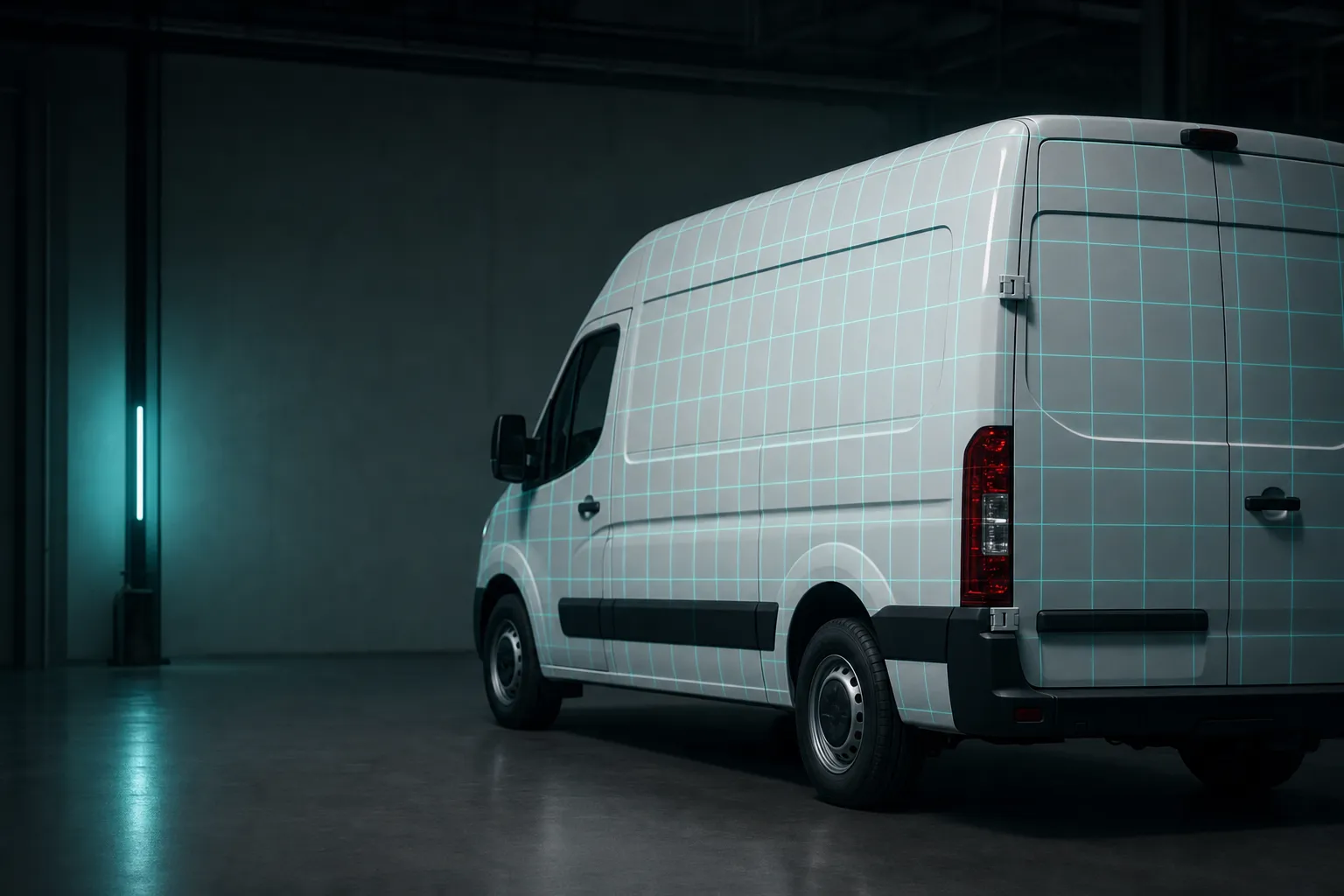
A vehicle wrap that installs clean and reads from the road is decided on screen, not in the bay. Three decisions do most of the work: a template you have checked against a tape measure, artwork placed around the seams, handles, and body lines instead of across them, and lettering sized for the distance and speed at which people will actually see it. Get those right and the installer's job is craft. Get them wrong and the installer's job is damage control.
I art-directed and production-managed wraps at This Creative in Fort Myers from 2015 to 2020, and supervised and installed graphics on vehicles myself; the wrap work in the WBX portfolio is the kind of thing I mean. This is the list I wish every designer had before their first file reached a printer; the bulletins and Florida rules are current as of September 2026.
How to think about it
A wrap is a print job on a substrate that is curved, seamed, riveted, and moving, with two audiences who want opposite things. The installer wants big shapes, forgiving seams, and nothing critical near a handle. The driver in the next lane wants one idea, in letters big enough to read in the two seconds they are looking.
Serve the installer first; a design that will not install is not a design. Then serve the driver with three things, in order: what you do, who you are, and how to reach you. The United States Sign Council's legibility rules of thumb (2006) set copy at no more than 40% of a panel, leaving at least 60% negative space, as the council's minimum standard. Most bad wraps I see break that rule before any other.
Step 1: Make the template and the tape measure agree
Vehicle templates in North America are drawn at 1:10 scale, with 1:20 for semis, trailers, and buses (Wraptor's July 2026 template comparison). Put the scale in the file name and in a note inside the file, then treat the template as a sketch and the tape as the authority. Templates are drawn from one model year and one trim; the truck in the lot has a ladder rack, a toolbox, or a wheelbase the template never heard of.
Before drawing, I photograph all four sides square-on and every detail that will interrupt the art: handles, mirrors, fuel door, rivet rows, badges, lights, the cab-to-box seam. I measure length, height, and beltline and write the numbers on the template. Ten minutes with a tape saves a reprint that costs more than the design fee.
Step 2: Where should the seams and handles land?
Never across a seam. 3M's vehicle application bulletin (Rev C, July 2026) says to cut the film at every body seam, because seams flex and uncut film pulls away and fails early. Avery Dennison's IB 6.40 says the same, adds a minimum 0.5-inch panel overlap, and specifies the sequence: rear to front and bottom to top, shingled so wind and car washes cannot lift an edge.
Every seam turns the artwork into two pieces of film that someone aligns by hand on a curved surface. Big shapes and soft gradients survive that; thin rules, small type, and outlined logos do not. Keep type inside a panel and let color blocks cross the gap.
On the HB Marble and Granite van, the sliding-door handle lands on the edge of the HB logo block, right against the H. It reads anyway because the letter is enormous and the handle is small, which is the entire trick: land a handle on the biggest, simplest element you have. On the Tropical Pools pickups, the name runs across the cab and the phone number, website, and CPC license number sit on the bed, so the cab-to-bed gap lands between them instead of through a word.
Rivets, corrugations, and deep channels get their own rules. Avery specifies cast film for rivets and compound curves, cuts corrugated panels along the top and bottom of each corrugation so the film does not tent, and calls for relief cuts in Sprinter-style recesses; 3M starts heat-stretching at least 8 inches from a recess and post-heats it, with primer in the deepest part. The Grate Fireplace box truck has rivet rows down the whole box, so the design runs a flame straight across them. A flame does not care where a rivet lands, and the logo and contact line are set large and bold enough to ride over the rows; a phone number in small type across them would look like a phone number with acne.
Step 3: How big does the lettering need to be at 40 mph?
The USSC rule of thumb is a Legibility Index of about 30: roughly 30 feet of reading distance per inch of capital letter height for a high-contrast sign. The council's worked example: at 40 mph a driver covers about 59 feet per second, so a 10-second reaction window is 590 feet, which at an index of 31 calls for 19-inch capitals.
That index assumes a sign facing the driver. A sign parallel to the road drops to an index of about 10: at 500 feet it needs 50-inch capitals where a facing sign needs 17. The side of your van, seen from the next lane, is a parallel sign. Nobody reads a phone number off a door at highway speed.
So the side panels carry the big idea, name and trade, in the largest type the panel allows. The rear doors carry the phone number and website, because the car behind you at a light is stationary, 20 to 50 feet away, and facing them head-on. The Grate Fireplace truck repeats logo, website, and phone on the roll-up door for that reason. For static reads, a Signworks Monterey chart that cites USSC gives 5- to 6-inch capitals as the best size at 50 feet and 8 to 10 inches at 100.
Three more USSC rules. All-caps copy needs about 15% more height than upper- and lowercase. Contrast and letterform matter more than hue: in the USSC table, externally lit black-on-white and yellow-on-green letters all land between 26 and 31 depending on the typeface. And the reaction-time figures assume six words or 30 letters at most, so the side of the truck gets one line, not a services list.
Step 4: What legal text does a wrapped truck need in Florida?
F.S. 489.119(5)(c) (2026 Florida Statutes): if a vehicle bears a contractor's name, or any text or artwork that would lead a reasonable person to believe it is used for contracting, the registration or certification number must be "conspicuously and legibly displayed with the name, text, or artwork." So the licensed trades in the portfolio carry the number on the wrap: CAC on the Morales A/C vans, CGC on the Grate Fireplace trucks, CPC on the Tropical Pools beds, CCC on the roofing pickups, CFC on the Perry Plumbing cab, some beside the logo or phone number and some in small type on a fender. Plan it into the layout with the name.
Interstate carriers fall under 49 CFR 390.21T: legal name or a single trade name plus the USDOT number on both sides, in letters that contrast sharply with the background and are legible from 50 feet in daylight while the vehicle is stationary. The regulation sets no minimum letter height; sign vendors recommend at least 2 inches for the 50-foot test, and temporary or removable markings are a recurring compliance problem. Florida's F.S. 316.302 applies the same federal parts to intrastate commercial vehicles, then exempts non-hazmat vehicles under 26,001 pounds from that subsection, so a typical Florida service van sits outside the marking rule and a heavy truck does not; both markings are line items on the brand audit checklist.
Windows and lights have limits too. Perforated film behind the driver must meet F.S. 316.2954 when tested with the glass: total reflectance 35% or less, transmittance at least 30%. Front side windows under F.S. 316.2953 stay at 25% reflectance or less and 28% transmittance or more, so they are not wrapped, and if the rear glass is covered F.S. 316.294 still requires a mirror view 200 feet back. F.S. 316.2397 bans red or blue light visible from the front, so keep reflective red off the nose. Trailers that need conspicuity tape under 49 CFR 393.11 keep it uncovered; I could not verify any rule that lets graphics cover it.
Step 5: Build the file so it prints and installs the way it looks
- Vector everything you can. Logos, type, and flat shapes stay vector; raster elements are built at final size for the stated scale, not pulled off a website.
- Extend art past every panel edge. Avery's 0.5-inch overlap is the minimum. Film stretches over curves and the installer trims to the body line, so art past the edge never ends in a hard border.
- Respect ink limits. 3M lists a maximum of 270% total ink for IJ180mC; Avery recommends 250% and 24 hours of drying before lamination. Rich blacks and gradients built for coated paper can exceed both, so ask the shop for its profile; the print color management piece covers why the screen lies about this.
- Panel the file the way it will be applied. Rear to front, bottom to top, panels named by position.
- Window perforation is its own layer. Per 3M, side-by-side perf panels butt rather than overlap and edges get sealed for durability; Avery rates perforated film for up to one year.
- Proof at full size. Print the section with the phone number at 100% and tape it to the wall. A 1:10 mockup on a monitor flatters everything.
The Morales A/C vans and the Tropical Pools pickups work as fleets because they are systems, not pictures: a logo block, a stripe, a fixed position for the phone and license, and rules for adapting them to the next model. Design the system once and the sixth truck takes an afternoon; design each truck as art and the sixth starts from zero. The logic of a logo system rather than a single logo applies at 20 feet long.
Mistakes I see
- Designing on a template nobody measured, then discovering the ladder rack.
- A 3-inch phone number on the side of the van, expected to read at 45 mph.
- Six services and two taglines on one door, well past 40% of the panel.
- Thin outlines, small type, or a wordmark crossing a door gap, a handle, or a rivet row.
- Art across the fuel door, over an emergency exit window, or onto rubber trim or unpainted plastic, which both manufacturers rule out.
- Fleets designed one vehicle at a time, so no two trucks match.
What it costs / what to expect
Wrap prices in 2026 vary about twofold between sources, and the low end is usually network pricing. From Wrapmate (updated May 2026), Hyperformance Graphics (2026), and CarWrapInfo (September 2026):
| Vehicle | Reported full-wrap range, 2026 |
|---|---|
| Sedan | $1,500–$4,500 |
| SUV or pickup | $3,000–$6,000 |
| Cargo van (Transit, Sprinter 170") | $3,500–$6,500 |
| Box truck | $4,000–$8,000 |
| Partial or spot wrap | $800–$2,600 |
| Cut-vinyl lettering only | $400–$800 |
Fleet discounts run 5–20%; matte or satin finishes add 10–20%. Design may be separate: Wrapmate lists $250 to $400, and Hyperformance folds it into the quote. WBX lists wrap design at $750–$2,500+ per vehicle on the pricing page as of September 2026; vehicle count and how much identity already exists move the number; the creative services page describes the work.
Lifespan: cast film under a UV laminate, washed regularly, is quoted at five to seven years. 3M's 10-year rating for IJ180mC white assumes a flat vertical surface, unprinted, unwarranted, and Northern European climate conditions, which a Florida parking lot is not; the same bulletin scores removability 2 of 5 toward "not designed for easy removal." Avery puts MPI 1105 at up to five years on the vehicle's painted surface; perforated window film, one year.
The "30,000 to 70,000 impressions a day" figure in every wrap sales deck has no reachable primary source, so I do not quote it. A clean wrap on a work truck is still the only billboard a trade business owns that parks in the customer's driveway.
Where to go next
Browse the vehicle wrap portfolio to see these rules on real trucks; my bio has the timeline. If the logo has no version that survives at 20 feet, start with the logo system piece; if the colors drift between van, card, and website, start with the print piece.
Wrapping a truck or a fleet?
Send me the vehicle list and the logo. I will tell you what needs to happen to the logo first.
Start a conversationQuestions people ask
- How big should the lettering on a vehicle wrap be?
- Use the United States Sign Council rule of about 30 feet of legibility per inch of capital height for a sign facing the viewer. A wrap seen from the next lane is a parallel sign, where the index drops to about 10, so put the phone number and website on the rear doors in 5- to 10-inch capitals and keep the side to one short line.
- Does a contractor's truck need a license number on the wrap in Florida?
- Yes. Under F.S. 489.119(5)(c), if a vehicle carries a contractor's name or any artwork that suggests it is used for contracting, the registration or certification number must be conspicuously and legibly displayed with it. Design the number into the layout near the name instead of adding it at the end.
- Can I wrap the windows of a van in Florida?
- Behind the driver, yes, with perforated film that meets F.S. 316.2954 when tested with the glass: total reflectance of 35% or less and transmittance of at least 30%. Front side windows must stay at 25% reflectance or less and 28% transmittance or more under F.S. 316.2953, so they are not wrapped, and you still need a mirror view 200 feet to the rear.
- How long does a vehicle wrap last?
- Trade sources quote five to seven years for cast film under a UV laminate with regular washing. 3M rates IJ180mC white at 10 years of expected life on a flat vertical surface, unprinted, unwarranted, and in a Northern European climate, and Avery puts MPI 1105 at up to five years on the vehicle's painted surface. Perforated window film is rated for about one year.
- What files does a wrap printer need?
- Vector artwork in AI, EPS, or PDF at a stated scale, usually 1:10, with the scale in the file name; raster images built at final size; artwork extended past every panel edge; blacks and gradients kept inside the film's ink limit, 250 to 270% for the common cast films; and a full-size proof of at least one section before the run.
Sources
- https://multimedia.3m.com/mws/media/2419563O/application-vehicles-ra-pdf.pdf
- https://graphics.averydennison.com/content/dam/averydennison/graphics/na/en/documents/Instructional-Bulletins/Special-Product-Information/ib640-vehicle-wrap-guidelines.pdf
- https://multimedia.3m.com/mws/media/1421606O/product-bulletin-ij180mc.pdf
- https://files.secure.website/wscfus/7691102/uploads/USSC_Sign_Legibility_Rules_of_Thumb.pdf
- http://www.leg.state.fl.us/Statutes/index.cfm?App_mode=Display_Statute&URL=0400-0499/0489/Sections/0489.119.html
- http://www.leg.state.fl.us/Statutes/index.cfm?App_mode=Display_Statute&URL=0300-0399/0316/Sections/0316.2954.html
- https://www.law.cornell.edu/cfr/text/49/390.21T
- https://hyperformancegraphics.com/vehicle-wrap-cost-2026/